Welcome
Thank you for volunteering to count Vaux's Swifts! Vaux's Happening is a west coast-wide community science project that tracks Vaux's Swifts as they gather in large numbers at communal roost sites during spring and fall migration. Volunteers like you watch these roosts at dusk and count how many swifts pour into a chosen chimney or roost for the night.
Why it matters: Vaux's Swifts are a species of conservation concern, and communal roosts — often old masonry chimneys — are becoming rarer as older buildings are demolished or renovated. The counts you collect help track population trends and make the case for protecting known roost sites.
This guide takes about 15–20 minutes to read, and you can always come back to it before a count.
Understanding Roost Behavior
As dusk approaches, swifts that have been foraging over a wide area start converging near the roost site. What you'll typically see, in order:
Staging — Small groups of swifts appear overhead, circling loosely. Numbers build gradually.
Swirling — As more birds arrive, they form a loose, swirling flock above and around the chimney. This can build for 20–40 minutes.
The funnel — The flock tightens into a spiraling column and begins pouring into the chimney opening, sometimes just a handful at a time, then in a rush.
Peak entry — The bulk of the flock enters in a concentrated burst, sometimes just a few minutes or even seconds long.
Stragglers — A handful of latecomers may trickle in after the main entry. Wait for several minutes of no activity before considering the roost settled.
Timing is tied to sunset, not a fixed clock time — expect the main event in the 20–40 minutes surrounding sunset, though this varies by site, night, and weather.
How to Count
This is the hardest skill to learn, so don't worry about getting it perfect right away — even experienced counters find large flocks challenging.
Why it's hard: swifts move fast, light is dim, and flocks can range from a few dozen to several thousand birds entering in a short burst.
Techniques:
Count in blocks. Group swifts into clusters of 5 or 10 as they enter and add up the clusters.
Use a clicker for a steady, moderate flow. For a slow trickle of individuals, a hand clicker can be more accurate than block-counting.
Estimate for large, fast bursts. When hundreds enter within a minute, estimate based on a known reference cluster.
Identify your peak count. Report your best estimate of the total that entered that evening — not just the biggest single burst.
Common errors to avoid: double-counting circling birds that haven't entered yet; confusing a few birds popping back out as new entries; missing a second entry point on structures with more than one opening.
Recording Your Data
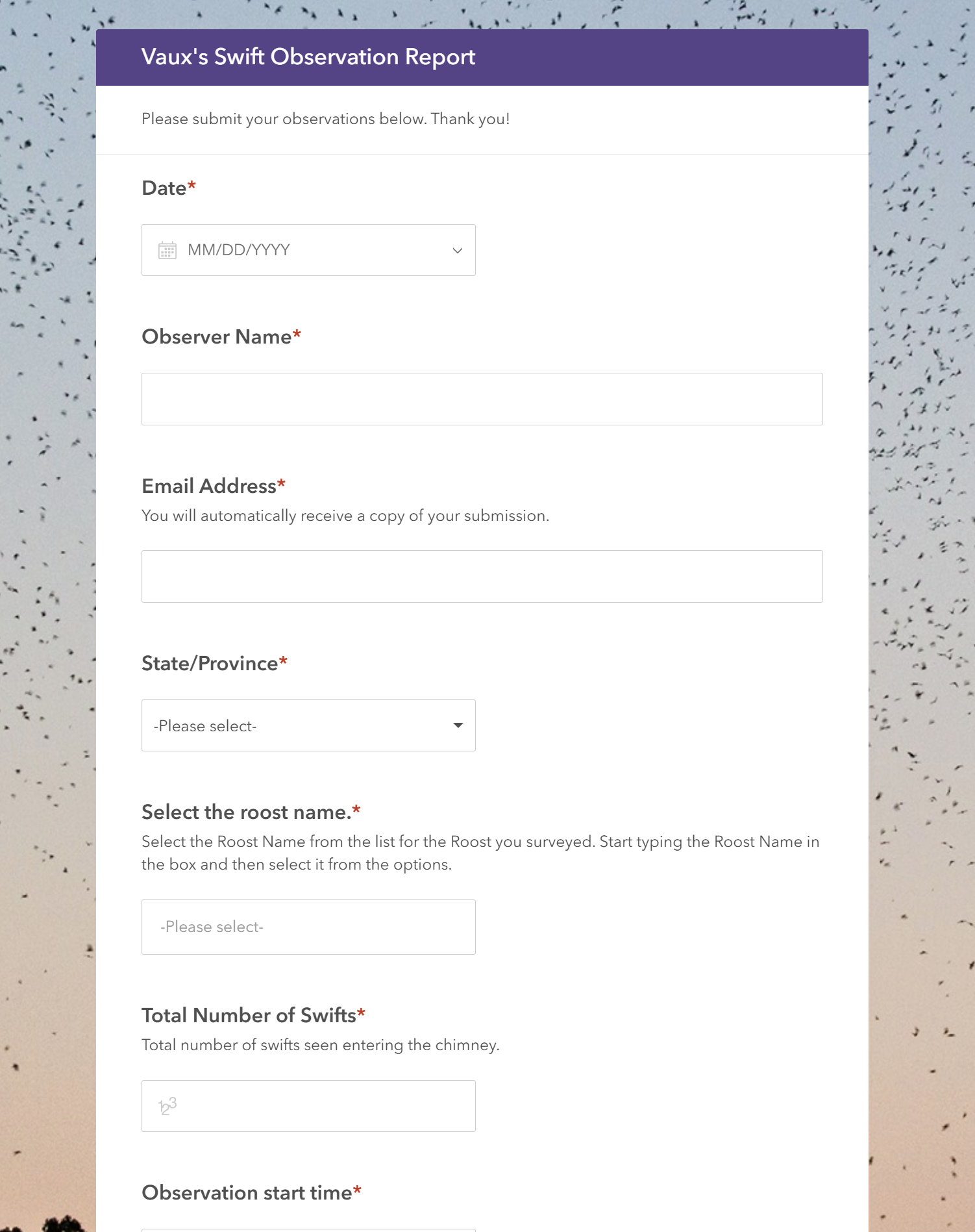
Record the following for every count:
Date
Site name
Observer name(s)
Time you see the first swift in the sky
Time you see the first swift go into the roost
Time you see the last swift go into the roost
Sunset time
Total count (best estimate)
Weather (temperature, wind, cloud cover)
Notes (predators, disturbances)
What to Bring
Chair or blanket — counts can take an hour or more
Layers — evening temperatures drop quickly
Flashlight or headlamp, for walking back to your car afterward
Clicker counter, if you plan to use one
Binoculars (optional)
This guide, or the count-methodology one-pager
Plan to arrive 1 hour before sunset and stay about 30 minutes after, depending on how quickly the roost settles.
Training Videos
Counting hundreds or even thousands of swifts is a skill that takes some practice. To help prepare or test your accuracy, we’ve provided several videos of swifts entering chimneys below. Below each, you’ll find a dropdown menu with the total number of swifts that entered the chimney in that video. How close are you to the correct total?
Videos coming soon!