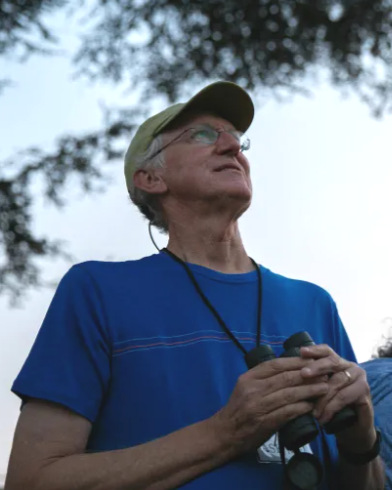
“I’ve traveled far to watch birds. Thailand, Laos, Cambodia. But seeing those 10,000 Vaux’s in one night, I’ve really never seen anything like that. Every direction I looked, they were as far as the eyes could see.”
Volunteer
Become a Vaux's Swift Roost Counter
Each spring and fall, thousands of Vaux's Swifts funnel into chimneys and hollow trees along their migration route, which stretches from British Columbia to Mexico, to roost for the night. And each migration season, a network of volunteers gathers at dusk to count them as they go in. No special training or experience is required. If you can sit outside for an hour and count birds (or help someone else count), you can be part of this.
The data volunteers collect is the backbone of what we know about how Vaux's Swifts are doing in our region: where they stop, how many are using each roost, and how those numbers are changing over time. It's real science, done by regular people with a lawn chair and a clicker counter.
New to counting? Please contact us before signing up for your first shift. We'll walk you through what to expect and pair you with an experienced counter for your first night.
What counting looks like
Roost counts happen at dusk during spring and fall migration: early April through the end of May in spring, and mid-August through late September in fall.
Volunteers gather near a known roost site (usually a large chimney) about 60 minutes before sunset.
As swifts begin circling and funneling in, counters tally the birds, usually in small groups (5s or 10s) rather than one at a time, since flocks can be large and fast-moving.
A count typically wraps up shortly after the last swifts have entered, or at full dark.
An online data form is used to report your count, start/end time, and weather conditions.
Counts happen rain or shine. Swifts may enter the roosts earlier in the day if the weather is rainy, so counters are encouraged to show up earlier on those days if their schedule allows.
First-time counters: please reach out to us before signing up for a shift. We pair every new counter with an experienced one for their first night or two, so we want to know you're coming and get you set up first.
Find your site and sign up
We have over 100 migratory roost sites across the West Coast, from British Columbia down to California. Sites are at different stages of getting set up with online scheduling:
Sites marked "Sign Up" have their own page showing open nights. Pick a date and reserve your spot directly. (First-time counters: contact us first, see above, before booking a slot.)
Sites marked "Email to Join" aren't on the online scheduling system yet. For these, click the email link and the assigned contact will help get you scheduled.
-
Courtenay Vancouver Museum → Email to Join
Cumberland → Email to Join
-
Bellingham
Assumption Church → Email to Join
Camas
Tavern → Email to Join
Centralia
Downtown → Email to Join
First Methodist Church → Email to Join
Chehalis
Downtown → Email to Join
Ellensburg
Botany Shop → Email to Join
Courthouse → Email to Join
Old Hospital → Email to Join
Fitterer’s Furniture → Email to Join
Joint Base Lewis-McChord → Email to Join
Lyle
Activity Center → Email to Join
Monroe
Frank Wagner Elementary → Email to Join
District Offices → Email to Join
Port Angeles
Catholic Church → Email to Join
Sedro-Woolley
Vic’s/Post Office → Email to Join
Old Northern State Hospital → Email to Join
Selleck
Old School House → Email to Join
Sequim
Dungeness Hatcher → Email to Join
Snoqualmie
Dirtfish Big Stack → Email to Join
Tenino
Auto Repair Shop → Email to Join
Washougal
Church → Email to Join
School Admin → Email to Join
Yakima
Astria → Email to Join
Auto Glass → Email to Join
Furniture Gallery → Email to Join
Newspaper → Email to Join
Ron’s Coins → Email to Join
Triumph Treatment → Email to Join
-
Coming soon!
-
Coming soon!
-
Don't see a site near you, or not sure which one's closest? Contact us and we'll help you find one.
Other ways to help
Counting at dusk isn't the only way to contribute:
Site scouting: help identify potential new roost sites (large chimneys, hollow trees) in your area
Site lead: become the point person for a site near you, helping coordinate other volunteers and train newcomers
Community outreach: table at a local event or help spread the word about the project
Landowner coordination: some roost sites are on private property, and volunteers who can help maintain those relationships are valuable
Interested in taking on more, like becoming a site lead? Mention it when you reach out, or contact us directly.
Good for families, students, and first-timers
Watching thousands of birds pour into a chimney in a matter of minutes is one of the more dramatic things you can see in an urban setting and is genuinely fun to witness. Roost counts can be good ways to engage family and friends, and we encourage you to bring the kids, a friend who’s never birded before, or a neighbor to join on your count (as long as they won’t distract you from counting!).
Students working on school projects are also encouraged to join a count as a way to see the data-collection process firsthand.
See our Data & Downloads page for the dataset itself.
Remember: if this is your (or their) first count, contact us first so we can set you up with an experienced counter.
Questions?
Reach out to Larry (leschwitters@me.com) if you have questions about a specific site, need to join a site that isn't online yet, are counting for the first time, or want to talk about a bigger role like becoming a site lead.
Related resources
Cover photo by Olivia Vanni